

The attempt to portray family-centred advocacy as foreign-inspired opposition to human rights overlooks an inconvenient fact: the family is itself protected by Kenyan, African and international human-rights law.
There is something increasingly peculiar about the debate over family, sexuality and reproductive policy in Africa.
When organisations promote sexual and reproductive health and rights, comprehensive sexuality education, abortion liberalisation or new reproductive technologies, their advocacy is frequently described as advancing human rights. When African religious leaders, parents, parliamentarians, lawyers and civil-society organisations defend marriage, parental responsibility, the protection of children and the cultural institution of the family, their advocacy is increasingly described as an ideological “campaign”.
Why the double standard? A recent sponsored article by Nickson Kimeta portrays the promotion of “African family values” in Kenya as part of a well-resourced campaign against sexual and reproductive health and rights. It raises questions about foreign funding and warns against presenting one worldview as authentically African. Those questions are legitimate. But they must apply equally to everyone.
If foreign funding can influence organisations defending family values, foreign funding can equally influence organisations promoting SRHR. If transparency is important for conservative organisations, it is equally important for progressive organisations. And if Africans should resist outsiders defining what constitutes “African values”, they should equally resist outsiders determining which understandings of sexuality, reproduction, childhood and family African governments must adopt.
That is not anti-human-rights rhetoric. It is the language of equality, democracy and self-determination.
Family rights are human rights. The suggestion that family-values advocacy somehow sits outside the human-rights tradition is particularly difficult to reconcile with the law.
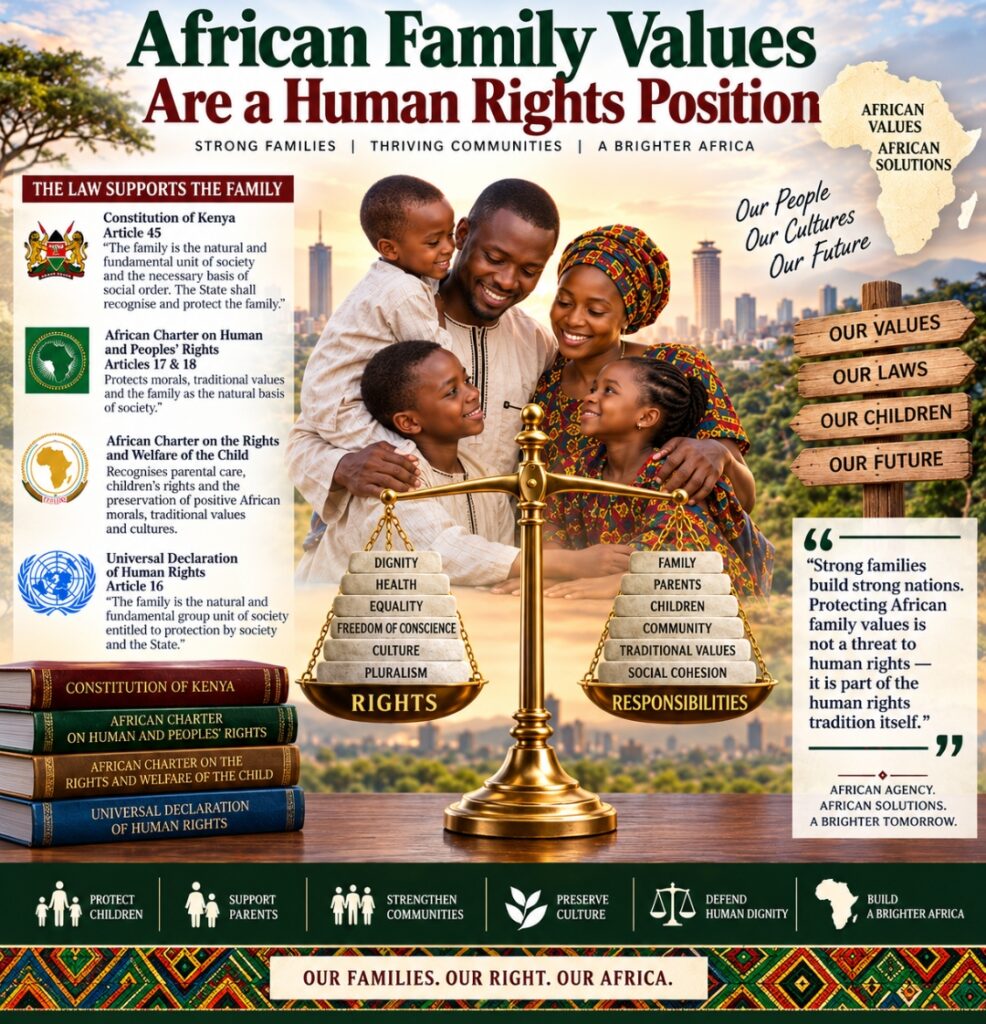
Article 45 of the Constitution of Kenya declares: “The family is the natural and fundamental unit of society and the necessary basis of social order.”
It consequently requires recognition and protection of the family by the State. This is not merely Kenyan constitutional language.
Article 18 of the African Charter on Human and Peoples’ Rights declares the family the “natural unit and basis of society” and requires the State to protect it. Remarkably, the Charter goes further and describes the family as the custodian of morals and traditional values recognised by the community. Article 17 separately places a duty upon the State to promote and protect morals and traditional values recognised by communities.
That language was not imposed upon Africa by American conservative organisations. It was negotiated and adopted by African States.
The African Charter on the Rights and Welfare of the Child is equally explicit. It recognises the child’s entitlement to parental care and protection and identifies parents as bearing primary responsibility for children’s upbringing and development. Its provisions on education expressly include the preservation and strengthening of positive African morals, traditional values and cultures.
Nor is protection of the family uniquely African. Article 16 of the Universal Declaration of Human Rights recognises the family as the natural and fundamental group unit of society entitled to protection by society and the State. The International Covenant on Civil and Political Rights repeats substantially the same principle.
Defending the family, therefore, is not a rebellion against human rights. It is part of the human-rights tradition itself.
We must agree that Children have rights too. The contemporary SRHR debate also risks treating autonomy as though it were the only relevant human-rights principle.It is not. Dignity matters. Equality matters. Health matters. Freedom of conscience matters. Privacy matters.
But children also have rights. Parents have responsibilities. Families have legitimate interests. Communities possess cultural rights. Peoples possess rights to self-determination.African human-rights law deliberately holds these principles together.
The African Children’s Charter recognises the best interests of the child, health and education while simultaneously recognising parental guidance, parental care, parental responsibility and positive African cultural values.
A mother or adolescent seeking medical care deserves dignity and appropriate healthcare. But acknowledging that proposition does not automatically settle difficult questions concerning abortion, parental consent, the sexualisation of children, surrogacy, embryo destruction, commercial reproductive technologies or the rights and responsibilities created by human reproduction.
Calling these matters “SRHR” cannot substitute for democratic argument. Technology deserves scrutiny, not slogans
Assisted reproductive technologies provide an excellent example. The difficult questions surrounding surrogacy, gamete donation and embryo transfer are not answered simply by declaring them reproductive healthcare. Who is the mother in a commercial surrogacy arrangement—the genetic mother, gestational mother or commissioning mother?
What happens when contractual expectations collide with the interests of a child?Should human gametes be commercial commodities? What protections should apply to economically vulnerable women recruited as surrogates? What becomes of unused embryos?
These are questions of dignity, exploitation, children’s rights, family law and bioethics. They deserve legislation grounded in evidence and public deliberation—not the assumption that technological possibility automatically creates a human right.
Africa is plural—but Africa has a voice. Kimeta correctly observes that Africa is not a single culture. Indeed it is not. But pluralism cannot mean that African culture becomes relevant only when Africans agree with fashionable international policy preferences.
African societies contain Christians, Muslims, traditional believers, secular citizens, conservatives, liberals and many others. Every one of them is entitled to participate in democratic debate.
A Catholic bishop does not surrender freedom of expression because he is religious. A Muslim parent does not lose parental rights because her convictions arise from faith. An African parliamentarian does not become an agent of foreigners merely because an organisation outside Africa happens to share his convictions.
Freedom of religion, conscience, expression and association belong to them too.The human-rights project becomes deeply selective when “rights” protect those demanding social change but become “foreign influence” when citizens organise democratically to resist it.
Researchers worth a name will follow all the money. Transparency about funding is important. Let organisations campaigning for traditional family policies disclose significant external support. Significant external support should demonstrate enhancing capacity to run nationwide programs.
But let organisations campaigning for abortion liberalisation, comprehensive sexuality education, contraceptive programmes, gender-policy reform and reproductive technologies disclose theirs as well. Let governments disclose the financial conditions attached to international development programmes.
Let sponsored media advocacy disclose who paid for it. The principle should be simple: Same transparency. Same scrutiny. Same democratic rules. Anything less converts “foreign influence” from a principle into a rhetorical weapon.
Family values need not deny anyone’s dignity
None of this requires denying the dignity of women, children or persons who live differently from the majority.
African family values worthy of protection must themselves respect human dignity. Harmful practices, violence, forced marriage, discrimination and abuse cannot acquire immunity merely by being called culture. Indeed, the African Children’s Charter expressly rejects cultural or religious practices inconsistent with protected rights.
That demonstrates the sophistication of the African human-rights framework: culture and human rights need not be enemies. African family values can simultaneously affirm human dignity, equality between spouses, protection of women, the best interests of children, parental responsibility, intergenerational solidarity, care for the elderly and society’s obligation to protect the family.
The real question is who gets to define Africa’s future
Africa should certainly be wary of foreign actors financing political or cultural agendas. But that concern cannot mysteriously stop at the door of organisations whose vocabulary includes “SRHR”.
African agency means Africans possess the intellectual and political capacity to debate competing visions of society themselves. Several African Constitutions protect the family. The African Charter on Human and People’s rights (ACHPR) protects the family. The African Charter on the Rights and Welfare of the Child protects the family. The Universal Declaration of Human Rights protects the family.The same instruments also protect dignity, equality, health, conscience and other fundamental freedoms.
The challenge, therefore, is not to abolish one set of rights in the name of another. It is to interpret them coherently. African families do not require permission from Washington, Brussels—or indeed from foreign conservative organisations—to believe that family, parenthood, children, faith, culture and community matter.
The defence of African family values is not necessarily a campaign against human rights. Properly understood, it is a demand that the full spectrum of human rights—including the rights and protections belonging to families, parents, children, communities and peoples—be taken seriously. If we are going to ask who funds that argument, fairness demands that we also ask who funds the argument against it.