

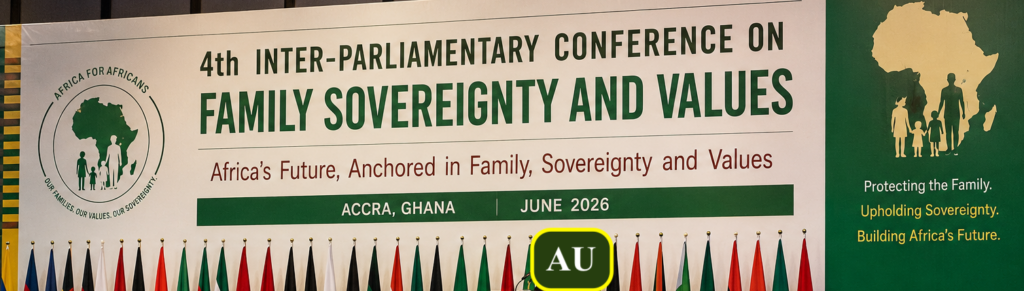
As delegates gather in Accra for the Fourth Inter-Parliamentary Conference on Family Sovereignty and Values (IPC), they do so against a backdrop of unprecedented controversy, international pressure, and sustained opposition. Yet supporters of the conference argue that these very attacks explain why the movement exists and why the Draft African Charter on Family Sovereignty and Values has become one of the most discussed political and social initiatives on the continent.
The story begins in 2021 with the conclusion of negotiations for what was then known as the Post-Cotonou Agreement, later signed as the Samoa Agreement. Critics within African political and legal circles contend that African peoples and their elected representatives were not adequately consulted during the negotiations. They further argue that the Agreement fundamentally restructured the traditional Africa-Caribbean-Pacific (ACP) partnership and weakened the collective parliamentary voice that ACP states had exercised through the Joint Parliamentary Assembly.
For many African legislators, however, the concern went beyond institutional restructuring. They viewed the Agreement as embedding a particular interpretation of human rights, including Sexual and Reproductive Health and Rights (SRHR), comprehensive sexuality education, and abortion-related policies, into international development cooperation frameworks.
Warnings emerged early. At the 2021 Annual Conference of the African Bar Association (AfBA) in Niamey, legal experts raised concerns about the implications of the Post-Cotonou Agreement. Similar warnings were reiterated during the Association’s 2022 Annual Conference in Malawi.

By the time the EU-ACP Joint Parliamentary Assembly met in Maputo later in 2022, a growing number of African parliamentarians believed a coordinated response was necessary. According to participants, a defining moment came when Uganda’s Deputy Speaker reportedly declared that the Parliament he led would not adopt policies that conflicted with its constitutional and cultural values. Delegates from Malawi proposed the creation of a continent-wide parliamentary process focused on family, sovereignty, and values.
The result was the birth of the Inter-Parliamentary Conference on Family Sovereignty and Values.
Uganda was selected to host the first conference. The decision came at a politically charged moment, as Uganda’s Parliament had passed its Anti-Homosexuality Act, which had drawn widespread criticism from Western governments, advocacy groups, and international media outlets. Supporters of the law argued that international commentary frequently mischaracterized its contents and ignored broader debates about national sovereignty and legislative independence.
Over the next three years, the movement grew. Conferences held in Uganda brought together parliamentarians, lawyers, religious leaders, academics, and civil society organizations from across Africa and beyond. Their work culminated in the publication of the Draft African Charter on Family Sovereignty and Values in 2025.
The Charter seeks to articulate an African approach to family policy, cultural identity, human dignity, parental rights, national sovereignty, and development. By 2026, several African countries—including Uganda, Senegal, Burkina Faso, and Ghana—had adopted or advanced legislation emphasizing family values and expressing reservations about aspects of the global LGBTQ policy agenda. Ghana’s Human Sexual Rights and Family Values Bill became one of the most prominent examples.
The publication of the Draft Charter triggered immediate opposition. Webinar after webinar was organized to challenge its contents. Side events opposing the initiative appeared at sessions of the African human rights system. Advocacy groups accused Charter supporters of undermining human rights norms, while Charter advocates responded that they were merely using the same legal, advocacy, and institutional mechanisms that had long been employed by proponents of SRHR-related reforms.
The controversy intensified as preparations began for the Fourth IPC in Ghana.
International campaigns were launched urging organizations and individuals not to attend. Petitions targeted pro-life and pro-family organizations abroad, encouraging them to distance themselves from the conference. Some organizations reportedly reduced their participation or limited themselves to sending goodwill messages.
Organizers also faced unexpected challenges. According to conference sources, online registration systems became the target of coordinated registration campaigns that overwhelmed the process. Organizers subsequently shifted to an invitation-only model.
Venue arrangements were likewise affected. The conference had initially been scheduled to take place at the Four Points by Sheraton Hotel. Organizers state that international pressure campaigns directed at the hotel chain ultimately forced a change of venue.
Meanwhile, controversy extended beyond the conference itself. Reports emerged that a planned honorary doctorate for Ghanaian President John Mahama from a U.S.-based institution had been withdrawn amid debates surrounding Ghana’s role in hosting the conference and supporting discussions on family sovereignty.
Yet, paradoxically, each challenge appeared to strengthen rather than weaken support for the event.
For many participants, the campaign against the conference became a real-world demonstration of the very issues the Charter seeks to address. Questions of national self-determination, democratic choice, cultural identity, legislative independence, and freedom of political association were no longer theoretical concepts. They were being tested in real time.
As delegates arrive in Accra, supporters argue that the Fourth IPC represents more than a conference. It is an assertion that Africans have the right to debate, define, and defend their own social and political priorities.
Whether one agrees with the Charter or opposes it, few can deny that the movement has evolved from a response to the Samoa Agreement into a broader continental conversation about sovereignty, family policy, development partnerships, and Africa’s place in a rapidly changing world.
And for its proponents, the lesson of the past five years is clear: every attempt to stop the conversation has only made it larger.