


Introduction
We known that occasional contraception has been used since Biblical times. It is only since the last sixty years that it has been possible to induce persistent infertility in a woman or to diminish the fertility of a large societal group or nation. The impetus to develop artificial chemical contraceptives was largely ideological. In the USA in the early 1900s large family size was strongly associated with poverty in the cities, but not in rural areas. The contraceptive mindset was partly motivated by wanting to alleviate the burden and perceived societal impoverishment of urban women with many children. It was also based on women’s desire for autonomy from men, so that women could choose when to become pregnant.1 There was also a deeper concern about a perceived link between overpopulation and societal and world poverty. In addition, eugenicists (like Malthus) were concerned about immigrants from countries outside of Northern Europe having large families and undermining the quality of society. They had similar views about children of handicapped parents. After 1945, concerns were raised about the large increases of population in India and Africa. The average total fertility rate in sub-Saharan Africa increased from an estimated 5.3 to 6.6 children per woman.2 A “Population Council” was set up in the USA to address the perceived crisis of overpopulation. It was feared that the population would outstrip the world’s resources if it was not reduced. Funding of research on contraceptives was started and by 1960 led to the hormonal contraceptive pill.
African Fertility Rates
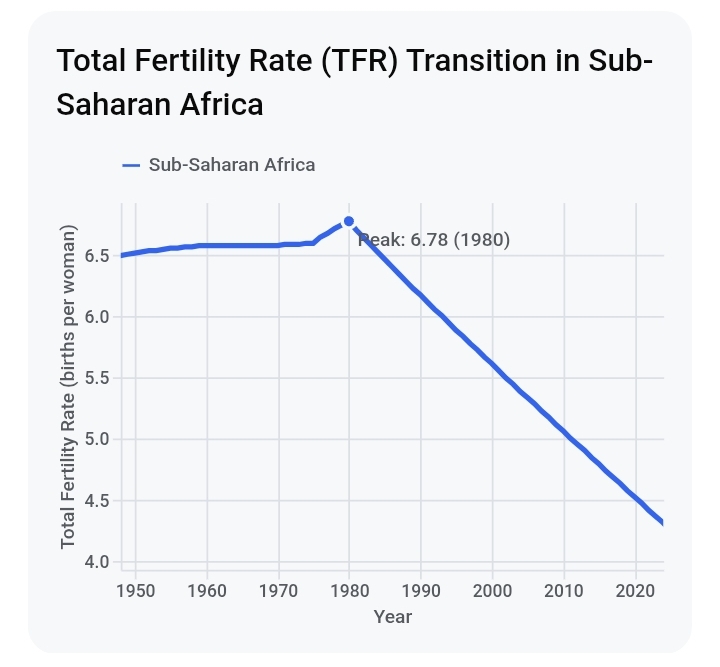
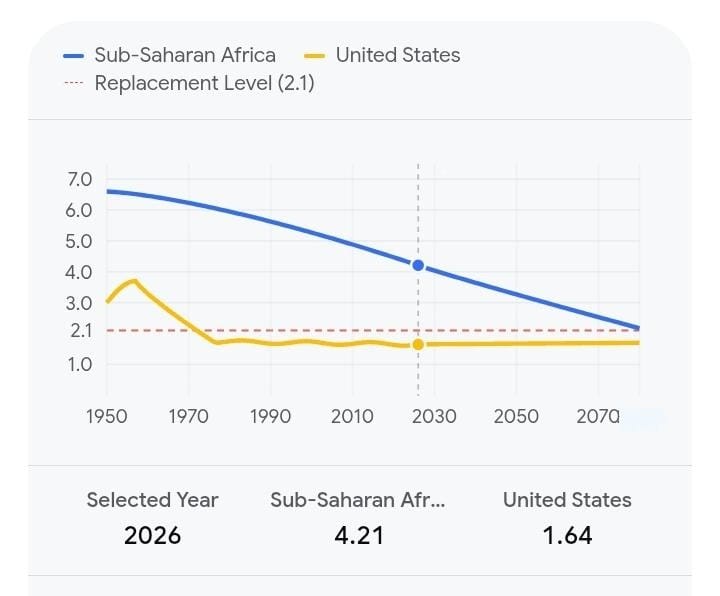
Sub-Saharan fertility rates are declining (figure 1). After 1950, births per woman increased to a peak in 1978 of 6.78, and have progressively declined every year since then. Compared to European (1.34) and American (1.60) fertility rates, African rates appear very healthy. However, the USA fertility rate was about 4.0 in 1957 but within 20 years of the introduction of contraception, it dropped below the “Replacement Level”3 of 2.1 (red dotted line in figure 2). In Africa, the fertility rate has been pushed down actively. For example in Ethiopia, over 30,000 female health extension workers gave out contraception and this caused the fertility rate to plunge by 3 children per woman since 1990,4 and at the current rate of decline, Africa’s population will fall below the Replacement Level within a generation. (figure 2)
Western Funding for Contraception
Huge amounts of money have been given for contraceptives and their distribution. From 2016 to 2024, US congress gave $607.5 million a year for global family planning and reproductive health, 50 to 70% going to Africa. USAID has given $3.4 billion for African family planning since 2001. The top African recipients are Nigeria, Uganda, Kenya and Tanzania. The Gates Foundation has given an estimated $3 billion for contraception. President Trump froze USAID funding in early 2025.
Morality and Aims of Funding Contraception in Africa
USAID’s international family planning program started under President Johnson in 1965. There has however, been little questioning about the morality of this massive blocking of natural human fertility by one country on the citizens of another. President Trump was the first to question this and to block USAID funding, although President George Bush did put in some restrictions. The US claims that these programs are never forced but started with local consent and not linked to other funding. In 1967, the United Nations Fund for Population Activities took on a major role in contraception.
The initial stated aim of contraception programmes was to reduce poverty and emancipate poor women. However, this evolved to reasoning that reducing the population was essential for economic development. Critics said however, it was cheaper for the West to cut poverty by reducing population numbers than to build effective health and economic infrastructure in Africa. From the 1990s there was fundamental change in the stated aim, and contraception is now seen essential “to empower women and for them to be able to control their own bodies”. Contraception is also seen as key to reducing high infant mortality and improving infant survival!
Demographic Problems
The primary explicit motive for these contraception programmes up to the 1990s was to reduce the size and growth rate of populous countries like Africa. However, many Western countries who have been using contraceptives since the 1960s now have serious problems with demographic collapse. For example, Europe is facing a “demographic winter” as its fertility rates remain below the 2.1 replacement level and the population is facing an irreversible decline.5
Contraception
Although the fertility rate in Sub-Saharan Africa is decreasing progressively, the fertility rate is still relatively high. However, 28 to 35% of women of reproductive age are now on contraception in Africa and the percentage is relentlessly increasing due to foreign funding. 50 to 58% of South African women are taking contraception and East Africa is showing rapid increase and is now at 40%. These figures are approaching the USA (54.3) and European (60 to 69) percentages and the West is still pouring money to increase African contraceptive use to their levels. As these rates go up the fertility rates go down and demographic collapse even in Africa becomes more and more inevitable unless contraception is stopped.
Contraception must be recognised as a major evil for society. Obianuju Ekeocha, Head of Culture of Life Africa, calls contraception “chemical warfare against women”. It is the doorway for divorce, abortion, loss of moral standards, normalisation of homosexuality and demographic collapse.6 Contraceptives can also cause abortion and the abortion pill (P2 or levonorgestrel) is also being used for contraception. In the encyclical letter Humanae Vitae, Pope Paul VI was concerned that contraceptives would lead to a weakening of morals in society. He clearly saw that reason, free will and self-denial are essential in responding to “the urges of nature” in marriage. Contraceptives can cause the virtue of chastity (loving the other person for their sake and not using them for our own ends) which is essential in marriage, to be lost. Contraception gradually undermines society and leads to increase in divorce, abortion, loss of gender identity and facilitation of homosexuality.
Pope John Paul II said that those who use contraception remove a God-given procreative capacity and claim a power over life that belongs to God alone. It is profoundly unlawful he said. It goes directly against God’s commandment to “go forth and multiply”. African Governments should also know that widespread contraceptive use puts their countries in danger from depopulation or takeover by populations with higher birth rates. It is essential that Africa acts now.
What should Africa do?
- Recognise that contraception is very dangerous for society and for marriage.
- It must be made illegal to import contraceptives, especially the cheap and dangerous long term subcutaneous implants that effectively “neuter” a woman.
- While contraceptives are still available, women must clearly understand all the side effects of contraception and give their free documented consent.
- Annual targets for lowering number of women on contraceptives and increasing fertility must be set up and tracked.
- Contraception-free communities such as the traditional Catholic Latin mass communities must be encouraged.
- Families with many children should be supported financially by the government.
- Africa must stop all contraception before it’s too late!
References
- Watkins, E.S. (1998) A societal history of Oral Contraceptives. Baltimore. Johns Hopkins University Press. ↩︎
- Horizon IRD. Fertility changes in sub-saharan Africa. https://horizon.documentation.ird.fr ↩︎
- The Replacement Level is the fertility rate below which, the population numbers start to decrease. ↩︎
- Popul Dev Rev (2020) 46: 409-441. Doi 10.1111/padr.12347 ↩︎
- Demographic collapse or “winter” means a precipitous decline in a nation’s population, leading to severe economic and social repercussions, which unless aggressively addressed can be irreversible and lead to the loss of the society. Vollset et al. (2020) The Lancet 396:1285. ↩︎
- Pullicino P. (2015) Oral contraceptive effects and Humanae Vitae. https://www.academia.edu/170990225/Oral_Contraceptive_Effects_and_Humanae_VItae ↩︎